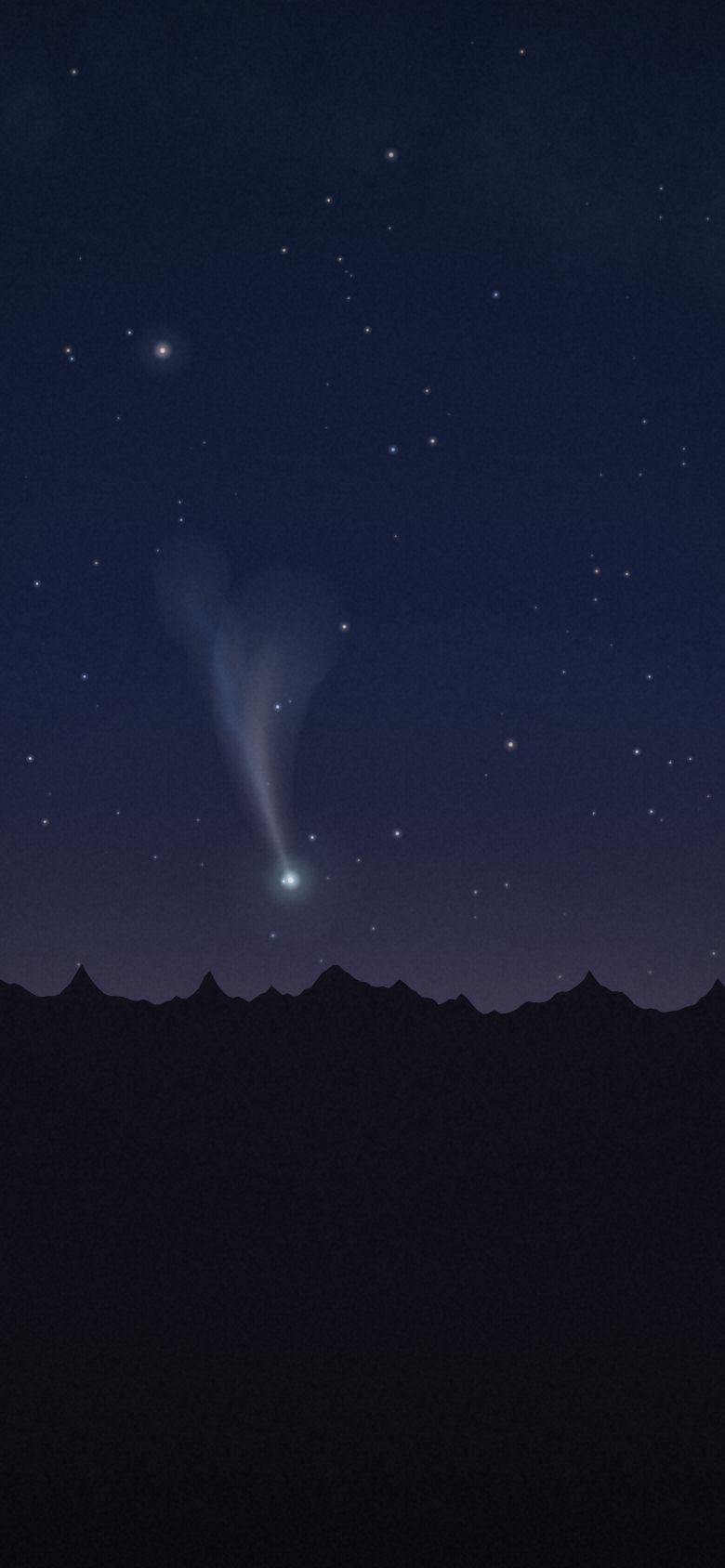
The Long Tail
A great comet from La Palma, Canary Islands — 8 vantage points, ranked.
- Top seat
- 84/100Roque de los Muchachos
- Clearest odds
- 88%Roque de los Muchachos
- Darkest sky
- B1Roque de los Muchachos
- Highest seat
- 2,420mRoque de los Muchachos
Why the seat matters
Bright comets live in the twilight wedge, ten to twenty degrees up, in the same part of the sky as every horizon obstruction and every layer of haze. La Palma stacks the deck: 2,400 m of altitude puts you above the trade-wind inversion, so you look down on the cloud deck instead of through it. The catch is that the island itself is a two-kilometre wall, and which side of it you are on decides whether you see anything.
- Season
- Rehearsal scenario
- Best months
- Whenever one arrives — historically about once a decade
- Cadence
- Unscheduled. It happens when it happens.
- Base
- Santa Cruz de La Palma
Dataset note. REHEARSAL SCENARIO. No bright naked-eye comet is currently predicted. This show exists to let you practise the vantage problem a great comet creates; the comet itself is simulated, not forecast.
Every seat, ranked
Seat fit is the simulator’s own score — darkness, open horizon, historical clear-sky odds, altitude and reachability, weighted for what this show cares about. It ranks seats against each other; it is not a forecast for any night. Tap a seat for the full card.
-
01
Roque de los Muchachos
Front row · 28.754°N 17.885°W 84 Bortle1Clear88%Blocked10%Seat fit 84/100 — Front-of-house seat for this show.
Above the trade-wind inversion, on top of the cloud, at the best-protected dark sky in Europe. Ninety-five minutes of hairpins and the road can shut without notice.
- Elevation
- 2,420 m
- Bortle class
- 1
- Sky blocked
- 10%
- Historically clear
- 88%
- Getting there
- 1 h 35 min drive + 10 min hike
- Facing
- 280°
- Facilities
- observatory road (may close for science), no facilities at night, sub-zero
-
02
Llano del Jable Astronomical Viewpoint
Front row · 28.627°N 17.850°W 77 Bortle2Clear84%Blocked6%Seat fit 77/100 — Strong seat. Weakest link: altitude.
A viewpoint built for exactly this, with a six-percent western horizon over black lava. Half the drive of the Roque for most of the sky.
- Elevation
- 1,290 m
- Bortle class
- 2
- Sky blocked
- 6%
- Historically clear
- 84%
- Getting there
- 40 min drive + 3 min hike
- Facing
- 275°
- Facilities
- purpose-built viewpoint, orientation panels, parking, no water
-
03
Refugio El Pilar
Mezzanine · 28.626°N 17.834°W 70 Bortle2Clear82%Blocked20%Seat fit 70/100 — Strong seat. Weakest link: altitude.
Shelter, toilets and pines — and the pines are the problem. A fifth of the sky is Canary pine exactly where a low comet lives.
- Elevation
- 1,450 m
- Bortle class
- 2
- Sky blocked
- 20%
- Historically clear
- 82%
- Getting there
- 45 min drive + 4 min hike
- Facing
- 270°
- Facilities
- picnic area, toilets, shelter, campsite
-
04
Mirador El Time
Mezzanine · 28.690°N 17.926°W 70 Bortle3Clear85%Blocked8%Seat fit 70/100 — Strong seat. Weakest link: altitude.
Six hundred metres straight above the sea with the Aridane valley below and nothing to the west but ocean. A cafe, a railing, and eight percent obstruction.
- Elevation
- 590 m
- Bortle class
- 3
- Sky blocked
- 8%
- Historically clear
- 85%
- Getting there
- 35 min drive
- Facing
- 265°
- Facilities
- car park, cafe, toilets, railings
-
05
Fuencaliente Lighthouse
Front row · 28.450°N 17.839°W 69 Bortle3Clear86%Blocked2%Seat fit 69/100 — Strong seat. Weakest link: altitude.
A two-percent horizon straight down onto the Atlantic — the lowest sightline on the island, which is everything for a comet setting in twilight.
- Elevation
- 30 m
- Bortle class
- 3
- Sky blocked
- 2%
- Historically clear
- 86%
- Getting there
- 55 min drive + 6 min hike
- Facing
- 250°
- Facilities
- car park, restaurant, toilets, salt pans
-
06
Puerto Naos Promenade
Balcony · 28.592°N 17.913°W 66 Bortle4Clear85%Blocked4%Seat fit 66/100 — Strong seat. Weakest link: altitude.
A black-sand promenade with a four-percent sea horizon and a bar behind you. Streetlights sit right in the sightline, which for a faint tail is fatal.
- Elevation
- 10 m
- Bortle class
- 4
- Sky blocked
- 4%
- Historically clear
- 85%
- Getting there
- 25 min drive
- Facing
- 260°
- Facilities
- hotels, restaurants, promenade, toilets, access restrictions post-eruption
-
07
Mirador de La Cumbrecita
Mezzanine · 28.700°N 17.848°W 63 Bortle2Clear83%Blocked32%Seat fit 63/100 — Strong seat. Weakest link: open sky.
Inside the Caldera de Taburiente with walls on three sides. Astonishing by day; for a low object it is a seat in a well.
- Elevation
- 1,290 m
- Bortle class
- 2
- Sky blocked
- 32%
- Historically clear
- 83%
- Getting there
- 50 min drive + 5 min hike
- Facing
- 260°
- Facilities
- permit needed for parking, toilets, railed viewpoint
-
08
Santa Cruz de La Palma Waterfront
Balcony · 28.683°N 17.764°W 48 Bortle5Clear81%Blocked34%Seat fit 48/100 — Workable compromise. Altitude is what you are paying.
The town is on the east coast and the comet is in the west, behind two thousand metres of island. Convenient and, for this show, nearly useless.
- Elevation
- 8 m
- Bortle class
- 5
- Sky blocked
- 34%
- Historically clear
- 81%
- Getting there
- no drive
- Facing
- 275°
- Facilities
- everything, ferry, airport 15 min
What is actually happening
Inside roughly three astronomical units the Sun's heat sublimates a comet's ices directly to gas, dragging dust with it. Two tails result and they point in different directions: the ion tail is blown straight anti-sunward by the solar wind at 400 km/s and glows blue from ionised carbon monoxide, while the heavier dust tail lags along the orbit and curves, scattering sunlight yellow-white. A great comet is a naked-eye object low in twilight, not a telescope target.
Other shows
 Aurora BorealisLofoten Islands, Norway
 Aurora AustralisTasmania, Australia
 Totality · 12 August 2026Northern Spain
 Moonrise EclipseHigh Atlas, Morocco
 The Perseid MaximumColorado Plateau, USA
 The Galactic CoreAtacama Desert, Chile
 The Glowing TideJervis Bay, Australia
 Silver CloudsNorthumberland & the Scottish Borders
 The MoonbowVictoria Falls, Zambia & Zimbabwe
 Fire on the HorizonMount Etna, Sicily
 Lenticular AlpenglowAoraki / Mount Cook, New Zealand
 The AnvilSonoran Desert, Arizona
 The MurmurationSomerset Levels, England
Front Row is a planning simulator on a curated dataset. Every place and coordinate is real; elevation, Bortle class, horizon obstruction and cloud odds are researched estimates for the site and season — climatology and site character, not a forecast. Background skies are rendered by the simulator, not photographed. Verify real conditions and access with an authoritative local source before you travel.
Open the simulator · All seat guides · Part of Rarest World